Raku is an ancient Japanese firing technique. When I had the opportunity to do some in high school, I was enamored, but our pottery unit was so brief I haven’t ever had the chance to do it again…until a couple of weeks ago at the John C. Campbell Folk School.
Raku is yet another pottery process for me to learn. Since it was a weekend class, we made our pots ahead of time from Raku clay, bisque fired them, and transported them to the studio ready to for the final firing. Our first class was a demonstration and then a few hours of glazing, using examples from our instructor to guide our choices. On Saturday we started early in the morning and fired pots all day long.
Raku is different from “regular” firing in several ways. A Raku kiln is propane fueled; therefore, it is outdoors rather than inside. Pots go into the kiln a few at a time and stay in there until they reach the desired temperature of 1900 degrees. This happens pretty quickly (approximately 30 minutes) as compared to an electric kiln, which takes hours. Once the pots are hot enough, they are removed from the kiln while they are still glowing using tongs and long fire proof gloves.
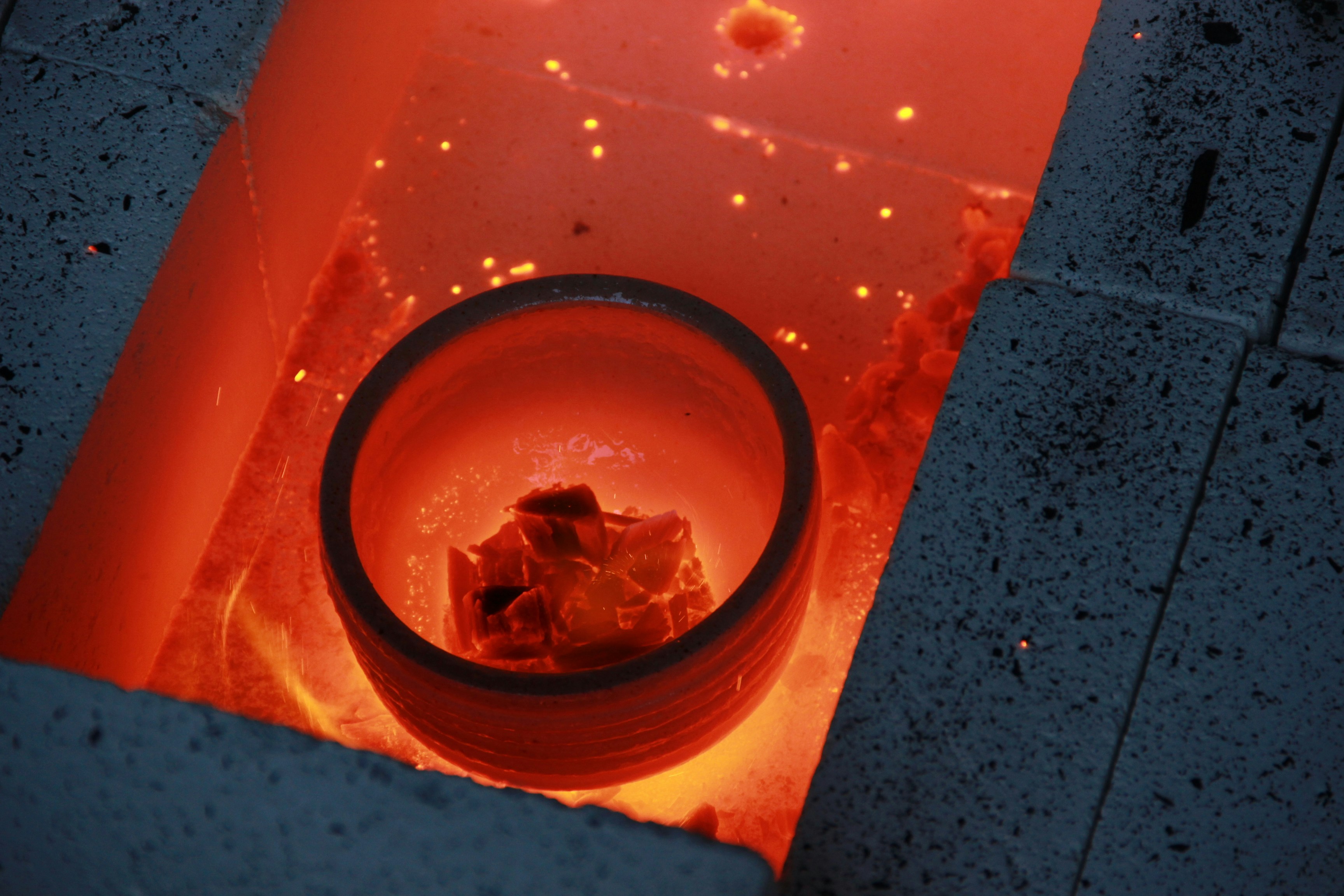
When the kiln is opened, the pots are radiating orange. It feels like we have found some lost treasure, like Indiana Jones. Removing the pots from their pedestals feels dangerous, not to mention the when the heat hits the face, the natural instinct is to run away. We have to plant our feet and mentally command ourselves to stay put. After picking up one pot at a time with tongs, they are moved to metal trashcans that have combustibles in them; we used newspaper. Each trashcan holds three pots at one time.
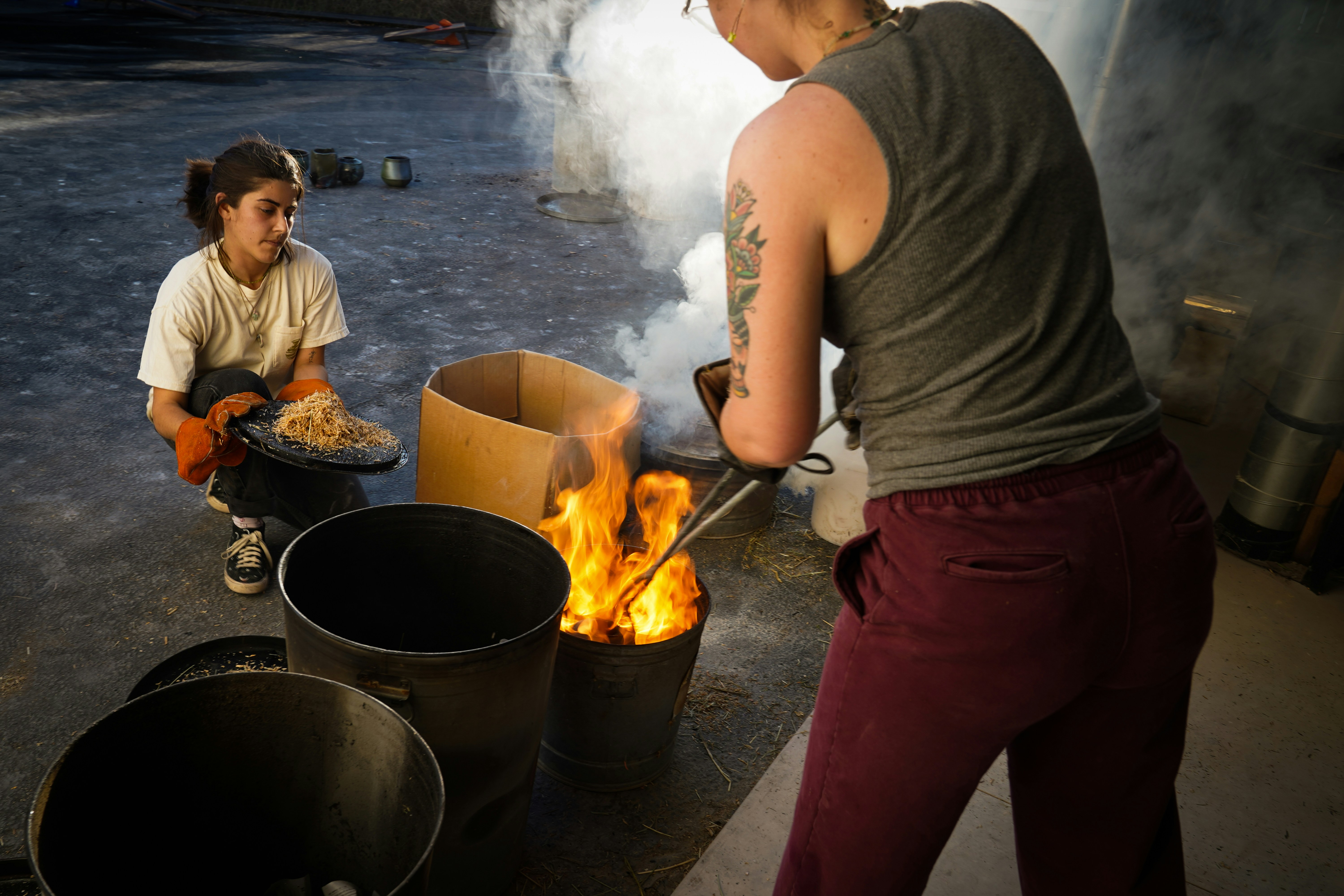
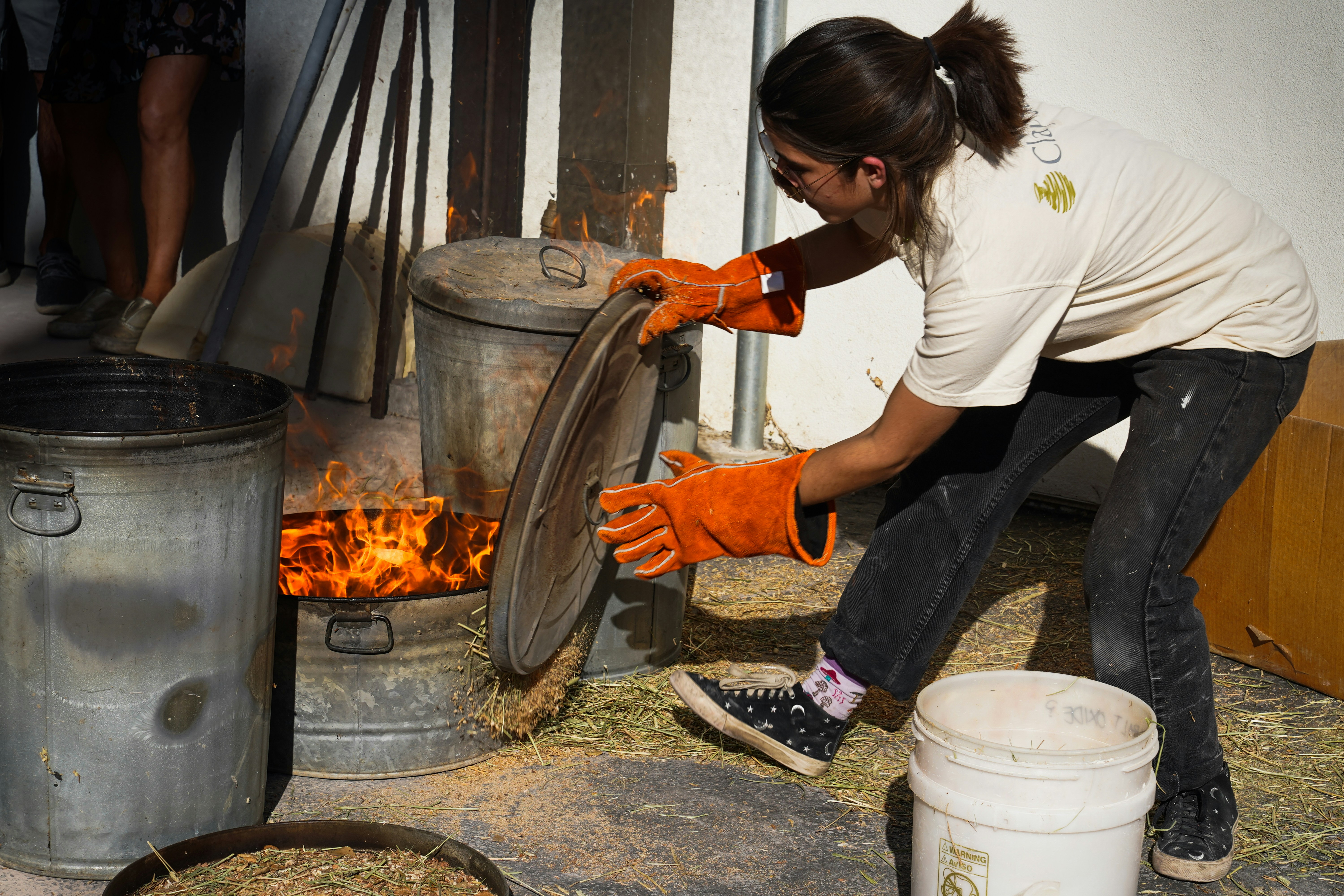
When the first glowing pot goes in the trashcan, the newspaper flames up immediately. Once the other two are added, the lid goes on tight. There is a great deal of science involved in creating a reduction (low oxygen) environment. I don’t do science very well. Here’s my simplified version. Fire requires fuel (newspaper) and oxygen to burn. When the newspaper lights up, the lid goes on to deprive the fire of oxygen. This results in smoke, in addition to the heat, which combines with the clay and the glazes to create the magical effect that is Raku pottery.
Add more paper and this affects the end result. Add numerous glazes, horsehair, or something other than newspaper and that affects the finish. How long you leave it, how thick the clay is, if you plunge the pot into water immediately or allow it to cool on its own changes how it looks. If there is more than one type of glaze in the same can, it can change everything. In short, you never know what you are going to get, only that it will be unique and you will never be able to replicate it.
What I love about Raku is that the fire makes it organic and unpredictable. Getting the pots from the kiln to the cans is tricky. Once the newspaper flames up it makes it difficult to get the next two pots into the can. The flames are blinding. The heat is intense. The adrenaline is flowing.
Fortunately, our instructor had us practice before we added fire. Imagine the bottom of the trashcan is a clock. The first pot goes in at the 12:00 position. The second at 4:00 and the last one at 9:00. So, when the first one goes in and the fire is licking its way out of the can, I can remember where to place the next two pots even without being able to see anything. I am blinded by the fire, but because I practiced beforehand, I know just where to place the pots.
So, here’s the lesson. Have you ever felt like you were in a furnace? Life’s fires flaming all around you? It’s usually a crisis. A broken relationship. A bad diagnosis. An accident. An injury. A financial disaster. Suddenly, you can’t see. The fire is blinding you. You have no idea what happens next. You only know the heat is intense. The smoke is thick and you are totally blind.
Finding your bearings isn’t easy in tough spots like these. It is in these moments your previous experiences kick in. Forget what you don’t know, remember what you do. Where is your 12:00? Your true north? Your foundation? Plant your feet. Do not run. Do not curl up. Remember your bearings are still the same, with or without the flames. Faith. Family. Friendships. Those are the things you can count on to be true no matter how hot the fire. Those are your 12:00, 4:00, 9:00.
When you are blinded by the flames, go to what you know and what has served you in the past. The result will be something beautiful. Something that will be uniquely marked by the fire. It is called the kiss of the kiln. A special place on a pot that is different than the rest of the surface. A spot that is the alchemy of all the parts of the whole. It cannot be produced, only received as a gift.
Not every pot gets a kiln kiss. It is reserved for special moments. After you have faced the flames and you can breathe again, the heat has cooled, and the smoke has cleared, you will be stunning in a way that can only be described a kiln kiss. A scar from the fire you have been through. It is what makes you, you. No one goes through the heat in the same way. Your shape, your thickness, the smoke, the fire all play a part. Like a fingerprint, you are singularly significant. Each trial leaves its own mark. A kiln kiss. That is the life metaphor of Raku. That is the beauty of being blinded by the flames.

All images in this blog are from unsplash.com
 Michelle's Mosaic
A birth mark can be a kiln kiss; A scar can be a kiln kiss; or A slick-bald scalp crowning a face of struggling endurance, sense-of-humor, perserverence, patience, courage – a bald-crowned face of faith, emanating through eyes and smiles of love.—–Thank You again, Michelle —–luv, mary
Amen Mary.