Of course, our life experience of the last 36 years, is mainly with a catastrophic frontal lobe injury. Though the frontal lobe was the primary injury, it was not the only part of Bill’s brain that was injured. The brain is loose inside of your skull, like jello. The skull is hard and has ridges inside of it. So, when it gets hit in the front, there is a whiplash effect that causes injury to the places the brain hits inside of the skull. It kind of bounces around, and depending on the direction of the blow, there can be more injuries that happen within the skull.
In addition to the frontal lobe injury, Bill also had contusions in his occipital lobe and the medial temporal lobe (the hippocampus). The truck that pulled out in front of him had lumber hanging out of the back of it. That lumber crashed through the windshield and hit Bill in the center of his forehead, right between the eyes at 60 mph. Obviously, the highest impact in the front of his head caused the greatest injury. But the whiplash effect caused injury in the back of his brain as well, and in the center.
There was a guy in his unit at the hospital who had a motorcycle accident. His injuries were all over his brain because he was thrown a long distance and his head hit the ground several times. Two people can have the same sort of injury, to the same regions of the brain, and have very different symptoms and outcomes. Some recover to a higher level of functioning, mostly independent, and some stay at a lower level, with permanent disabilities.
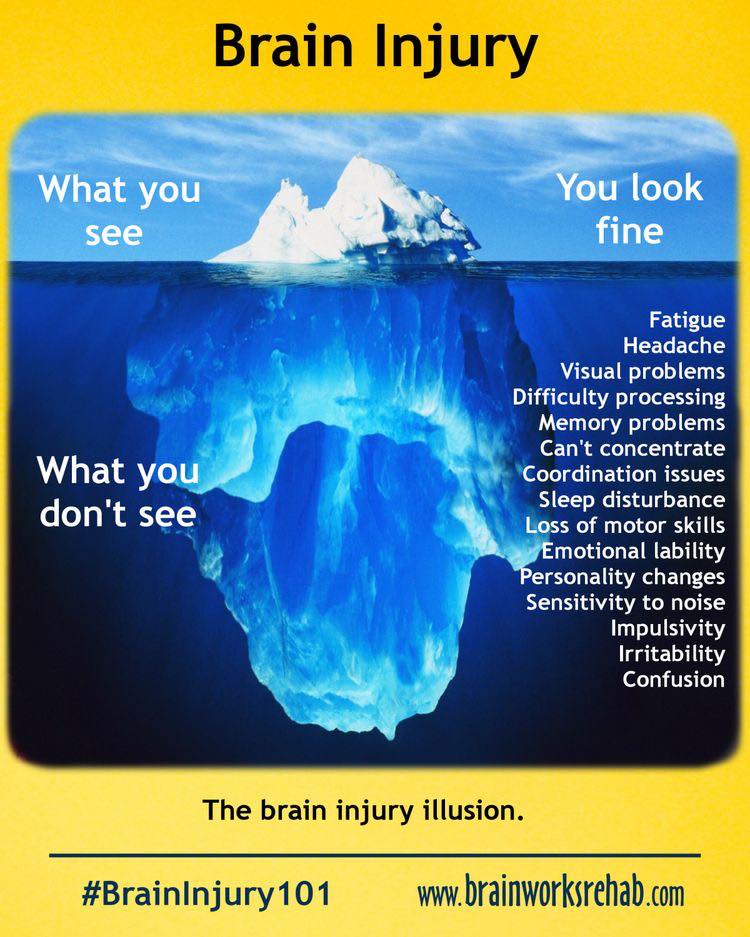
One thing I know to be true, you cannot see brain injuries with your eyes. To the public, these injuries are invisible. The person looks normal on the outside for the most part. Unless the severity of their wound also includes some physical injury, you will not recognize they are hurt. This is particularly frustrating for those with the damage. When they are limited in function, it is assumed they are just weird or “off.” Brain injury causes issues in social situations and in work settings. It is best to remember, you don’t know the story of others, and to have compassion if you see someone struggling.

A Day in the Life…
So, what does daily life look like for a brain injured person? Depends on the severity of the injury and where it is located. Bill’s sleep patterns are affected, so he either sleeps too much or he cannot sleep. It has vacillated greatly over the years for him, and sleep is something all of our brains need to reset, but this is particularly true of brains that are injured.
Bill may forget appointments. He may forget his medicine. He struggles to make decisions. He has a hard time pivoting in his mind if he needs to adapt to changes around him. Organization is very difficult for him. Finding things, his own tools for example, can be frustrating because they are often in plain sight but he misses them. He often gets places and realizes he has left what he needs at home. Or he gets home and realizes he left his tools behind.
His brain shuts down when it is overwhelmed by over work, or loud noises, or long days. Some days it never seems to get going at all. When it is out of gas, there will be no more activity. We will leave parties, or weddings, or concerts or movies in the middle when he cannot function. He needs silence once he gets to that point.
Social situations can be difficult as well. He may or may not be able to follow a conversation, especially in loud places. The information coming into his brain doesn’t filter, so he hears every sound in a place at the same volume. Tuning out background noise is getting harder and harder for him. When he is frustrated he gets angry at himself or others. If he lashes out, it is a signal that something is overwhelming, but he may not be able to tell you what it is.
His visual injury blocked out one quadrant of his peripheral vision. It was not his eyes that were the issue, but the signals his brain sent his eyes. The good news is that he gained the function back as his brain rewired itself, but it took years. The hippocampus is responsible for self-preservation through memory formation, pathfinding, and sense of time and place. His injury in this area is part of why he misplaces things, goes to the wrong place, and cannot measure time accurately. It is exhausting to live with these areas of injury, always trying to compensate. We have found strategies for keeping appointments and finding his way to places. Technology is our friend and has really helped over the years as it has progressed. He has done remarkably well. We are constantly adjusting and making new ways to work around the results of his injury.
Life for Louse, Bill’s mom, was drastically affected by her brain tumor. Hers was in her temporal lobe. Her first awareness of something wrong was when she couldn’t remember her grandkids’ names. Up until that point she had thought her memory lapses were related to aging. Then one day it rained and she began cussing like a sailor. If you knew Louise you know she never used cuss words under any circumstance. This was a major alarm. She went to the doctor and insisted on a brain scan immediately. The doctor was reluctant, but Louise demanded it. She had a cancerous brain tumor.
Once it was mostly removed, and she had radiation, her daily life was greatly altered. She couldn’t read any more. She had trouble finding words. She wandered around looking for things but she didn’t know what she was looking for. Her sequencing of events and activities was problematic. She put the wrong things in the microwave, and couldn’t remember what she was cooking. She had trouble with communication with words, and eventually lost a lot of language and conversations got more difficult for her to follow. Daily activities caused her frustration because she knew she used to be able to do these things. It was a very hard road for her and for us.
With my mom’s frontotemporal dementia, she first noticed she was having trouble with finding words. (aphasia) Then she started forgetting how to get places. Keeping up with medicine became hard because she couldn’t remember if she took it or not. She stopped being able to use the computer or her phone. She put sticky notes everywhere trying to remember things. She went to church and didn’t know anyone there, and she told Dad she couldn’t remember anyone. I was with her one day and she couldn’t remember how to roll down the window in the car or how to pump gas. She repeated the same stories over and over, and asked the same questions repeatedly.
Her daily life got smaller and smaller. She had a difficult time talking on the phone without Dad with her. Following multiple step directions became impossible. She gave up cooking, and driving, and computer work. She got to so she couldn’t read, one of her favorite pastimes. She could walk, but then forgot how. She could push herself around with her feet in a wheelchair, then she forgot how. Hers has been a steady decline, as is all dementia. The brain is injured from the inside, by disease. It is slow brain failure.
Ray, Bill’s dad, suffered from mini-strokes towards the end. He would be unable to speak. His blood pressure would shoot up very high. He would be very confused. The assisted living would call an ambulance but by the time we got to the hospital he was back to himself. These TIAs happened several times. He would be disoriented. Weak. If he tried to walk, he would collapse.
Once he was back home, his daily life was more measured. He stopped going out as often. He stayed around his place where he was more familiar. He couldn’t understand what was happening and he made up stories to explain it. These elaborate stories were logical to him but not to anyone else. He was insistent in his explanations. Then once, he wandered out in the night and he fell in the parking lot. He hit his head very hard and had to be in the hospital for a week. He was confused and disoriented. Belligerent at times, and very calm at others. He had to go to memory care after that. He was aware enough to know he was there and he wasn’t happy about it. He moved to live with Gail, Bill’s sister, and continued to have episodes of slurred speech, delusional thoughts, and falls until the very end.
These are four different types of brain injury we have navigated in our own family. All of them have similar symptoms based on the areas of the brain which are affected. As you can see, daily life is difficult with a brain injury. Again, this is a drop in the bucket. There are so many families affected by brain injury in one way or another, you would be shocked. So, when you see someone who is confused, or repeating themselves over and over, try to have compassion and realize that they may have a brain injury that you cannot see.

 Michelle's Mosaic
Thank you for your incredible explanation of brain injury. You are an example of patience and compassion for both your Bill, your mom and Bill’s family. I am sure that everyday can be challenging for you in many ways but because of your love for all these family members you excell. I know your faith is your strength. May you feel God’s comfort always.
Thanks! It is a huge issue for so many people.
Thanks, again, Michelle So much resonates with my past experiences with elderly dementia patients.
However, now your blog calls me to be patient with all people whose behavior puzzles me. We may be around someone who hasn’t been diagnosed.
luv, mary