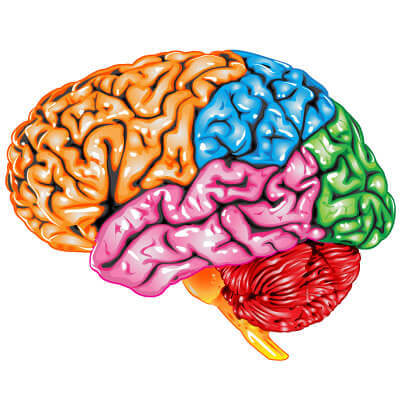
Here’s a color-coded picture of the brain. As you can see there are many parts. They are called lobes, and each one has a different function. The parts make up the whole, unless there is an injury to the brain, at which time, the healthy parts try to rewire to make up for the damaged ones.
Of course, when the brain is injured, whether from the inside or the outside, it is unlikely that only one lobe is affected. Usually, multiple sections are damaged which makes it especially difficult to figure out what is happening. I respect the brain and how astounding it is at trying to keep us alive at all times. It rewires, it adapts, it does miraculous things to make sure we can function as much as it is possible. The more I have learned the better understanding I have; however, the brain is mysterious and doesn’t give up all of its secrets. Each individual brain has its own ways to function and no two injuries are alike, making brain injury one of the most difficult medical diagnosis to treat.
Understanding the function of each part of the brain helps with recognizing which parts are injured based on the symptoms of the patient.
The Frontal Lobe (orange) is responsible for attention, concentration, self-monitoring, organization, expressive language (speaking), motor planning and initiation, awareness of abilities, awareness of limitations, personality, mental flexibility, inhibition of behavior, emotions, problem solving, planning, and judgment. An injury to the frontal lobes may affect an individual’s ability to control emotions, impulses, and behavior or may cause difficulty recalling events or speaking.
The Temporal Lobes (pink) are where memory is stored, also receptive language (understanding), sequencing, hearing, and organization. An injury to the temporal lobes may lead individuals to demonstrate difficulty with communication or memory.
The Parietal Lobes (blue) are responsible for sense of touch, depth perception, identification of sizes, shapes and colors, visual perception. Individuals who have injured their parietal lobes may have trouble with their five primary senses.
The Occipital Lobe (green) is where vision is stored. An injury to one’s occipital lobe may lead to trouble seeing or perceiving the size and shape of objects.
The Cerebellum (red) is responsible for balance and coordination, skilled motor activity, and visual perception. An injury to the cerebellum may affect balance, movement, and coordination.
The Brain Stem (yellow) is critical to survival. It controls breathing, arousal, consciousness, heart rate, and sleep/wake cycles. The brain stem controls the body’s involuntary functions that are essential for survival, such as breathing and heart rate.
If all of this isn’t enough to boggle your mind, the lobes can be divided into sides as if the brain is split right down the middle. The right side of the brain is responsible for the left side of the body and vice versa. The wiring is very complex, but there is some general recognition of certain traits used after an injury to determine which parts of the brain are affected.
The Left Side is responsible for analytical thinking, logic, preciseness, organization, literal thinking. Injuries of the left side of the brain can cause, difficulty understanding language or speaking it, depression, anxiety, impaired logic, sequencing problems, and decreased control over ride side of the body.
The Right Side is responsible for creativity, imagination, intuition, conceptual thinking, empathy, and figurative thinking. Injuries to the right side of the brain affect visual-spatial tasks, visual memory, awareness of deficits, altered creativity and musical perception, loss of “big picture” thinking, and decreased control over left side of the body.
All of this information just scratches the surface of brain function. In other words, this is what they explain to the lay person. It’s like brain injury 101; the most basic information you can get. Each of these areas of the brain has multitudes of other, more in depth, specialties. Layers upon layers of words I can’t pronounce, much less understand. However, even with this tiny amount of knowledge, it is possible to begin to see which areas of the brain could be affected by injury; which symptoms are manifested in behaviors that can be observed.
In part 3, I will give some examples of what it looks like in the day to day life of someone with a brain injury.
All the information in this blog was obtained from this website. https://www.biausa.org/brain-injury/about-brain-injury/what-is-a-brain-injury/function-of-the-brain
 Michelle's Mosaic
WHEW! Thanks, Michelle. This is a reminder of how complicated TBI is and challenging to the professionals who work with it and especially that it impacts the victim and family as only they can appreciate. – looking forward to the next blog. – luv, mary
So very complicated…