March is brain injury awareness month. This morning, when I told Bill that I was writing about brain injury awareness, he said, “I’m already aware of it, thanks.” And he certainly is, as am I. But the rest of the world probably isn’t, so I thought I’d give you some information.
Kinds of Brain Injuries
Acquired brain injury is when brain function is affected from within. These kinds of injuries are caused by strokes, aneurisms, oxygen supply cut off during heart attack or some other event, brain tumors, and diseases like dementia.
TBI (traumatic brain injury) is when the brain is injured by an outside force. The Brain Trauma Foundation states that “each year about 2.5 million individuals have TBIs of which approximately 50,000 result in death, and over 80,000 suffer permanent disability.” That is a lot of people and a lot of families.
Open and Closed Head Injuries
Within the TBI category, there are open and closed head injuries, which are defined just like they sound. An open head injury is when something penetrates the skull going into the brain, such as a bullet, or a blunt force object. When Bill was in the hospital, the guy next door had a fencepost go through his head in a car accident. Open head injuries are severe and most cause permanent disability.
Closed head injuries are when your brain gets bounced around inside your skull from a blow to the head. It can be from a car accident, a fall, or helmet to helmet contact. This causes swelling and bruising of the brain, which is damaging because there is no where for the pressure to go. The results vary in intensity from mild to severe depending on how hard the blow to the brain was and which area of the brain is affected. Bill’s accident resulted in a closed head injury when lumber hanging out of the back of a truck hit him in the head at 60 mph. He says he knew being hard headed would come in handy someday! It’s a miracle his skull was not cracked open.
Severity of Brain Injury
- Mild TBI and concussions are injuries to the brain that are called mild because they are not life threatening, but they are real and should be treated by a medical professional. These are the kinds of injuries that come from contact sports, falls, and other events where there is a blow to the head.
- Moderate or Severe TBI is caused by an external blow to the head which is hard and the person loses consciousness for a time. These are life threatening injuries. Survival is questionable, and recovery will include ongoing symptoms and the possibility of permanent disability.
The Glasgow Coma Scale is a neurological scale used to determine the severity of impaired consciousness in all types of acute medical and trauma patients. It was developed in 1974 at the University of Glasgow. It evaluates three aspects of responsiveness: eye opening, verbal response, and motor response.
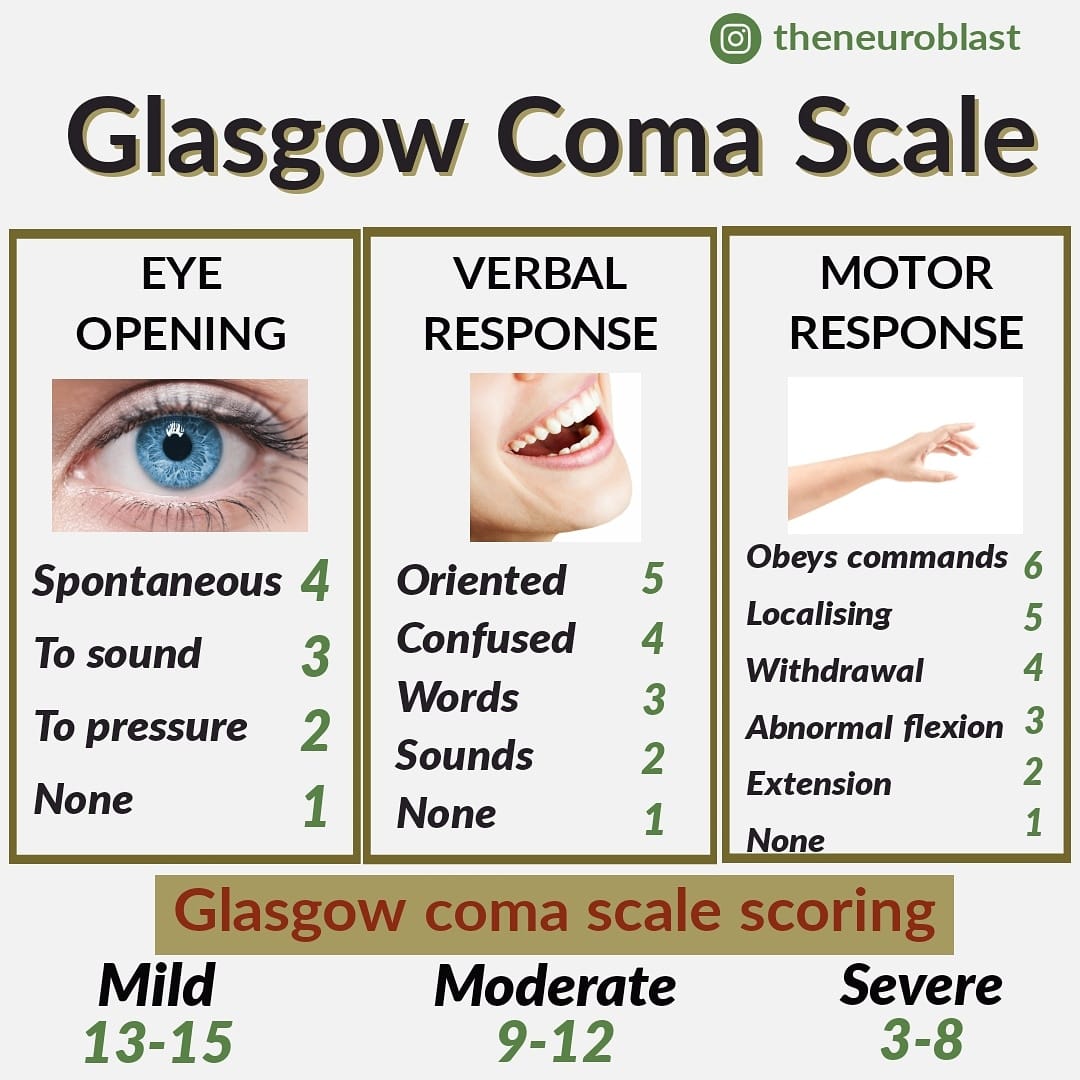
Based on this scale, since Bill had no response at the scene of his accident, his injury was classified as a severe TBI. Once he was “awake” he was on the lower end of the scale for a while. He was in ICU and it was unclear if he would live or not. Then, over the course of his hospital stay, he moved up the scale. For example: He moved from no response, to making sounds, then crazy nonsensical words to confusion. Eventually, he became more oriented, but it still took years for him to recover.
If you don’t know our TBI story you can click on the Brain Injury tab above to read about it. Later this week, I will post more about the lobes of the brain and their functions. I don’t want to overwhelm you with too much information on the first day! Here are some websites where you can find more information.
https://www.alz.org/alzheimers-dementia/what-is-dementia/related_conditions/traumatic-brain-injury
 Michelle's Mosaic